Do I need to keep accounts?
Yes – if you're self-employed in Switzerland, you always have to keep accounts.
This also applies if your sole proprietorship is not registered in the commercial register. In simple cases, an overview of income and expenses is enough, but depending on your situation you may have to keep proper books.
Do I have to keep double-entry books?
Proper bookkeeping is required by law in these cases:
- If you have set up a GmbH or AG
- For sole proprietorships or general partnerships with annual revenue of CHF 500'000 or more
In these cases, an income and expense statement is not enough and you need double-entry bookkeeping. That said, proper bookkeeping often pays off – for VAT, for example – even for businesses that are not yet required to keep it.
The obligations for proper bookkeeping are set out in Art. 957a of the Code of Obligations.
Full vs. simplified bookkeeping
What is the difference between full and simplified bookkeeping?
Full bookkeeping
With full bookkeeping, you have to keep double-entry books – with a balance sheet, income statement and inventory.
- Full bookkeeping gives you better reports. You can see more easily how well your business is doing.
- You're on the safe side with taxes, because you can always present correct financial statements and returns.
- If you keep clean books from early on, you save yourself a lot of work later.
Simplified bookkeeping
With simplified bookkeeping, it's enough to record your income, expenses and financial position in an overview. This works if you don't have many jobs yet when you start out.
- It is a legitimate option as long as you don't have many jobs yet and your revenue is relatively small.
If you're registered for VAT or opt into VAT voluntarily, VAT returns can become tedious without full bookkeeping.
Do I have a business?
If you work under your own name as a self-employed person, you automatically have a sole proprietorship, even if you are not registered in the commercial register – for a sole proprietorship, registration is not mandatory up to CHF 100'000 in annual revenue. Simplified bookkeeping is already required at that point.
Your official business name on invoices
- Even if you trade under a made-up name as a self-employed person (e.g. Studio11), your surname must also appear in the official business name on invoices (e.g. Studio11 Holzberg).
- General partnerships, AGs and GmbHs are completely free to use made-up names, as long as the legal form is included.
Registration and personal liability
To register your business in the commercial register, you can apply via EasyGov, the federal government's online portal for setting up a business.
- With a sole proprietorship, you always have unlimited liability for debts – meaning with all your private assets – whether or not your business is registered.
- With a GmbH or AG, liability is limited to the company's assets, but a minimum capital is required.
What is double-entry bookkeeping?
Double-entry bookkeeping is a widely used system for recording transactions. Every transaction is always recorded in two places – which is where the term "double-entry" comes from.
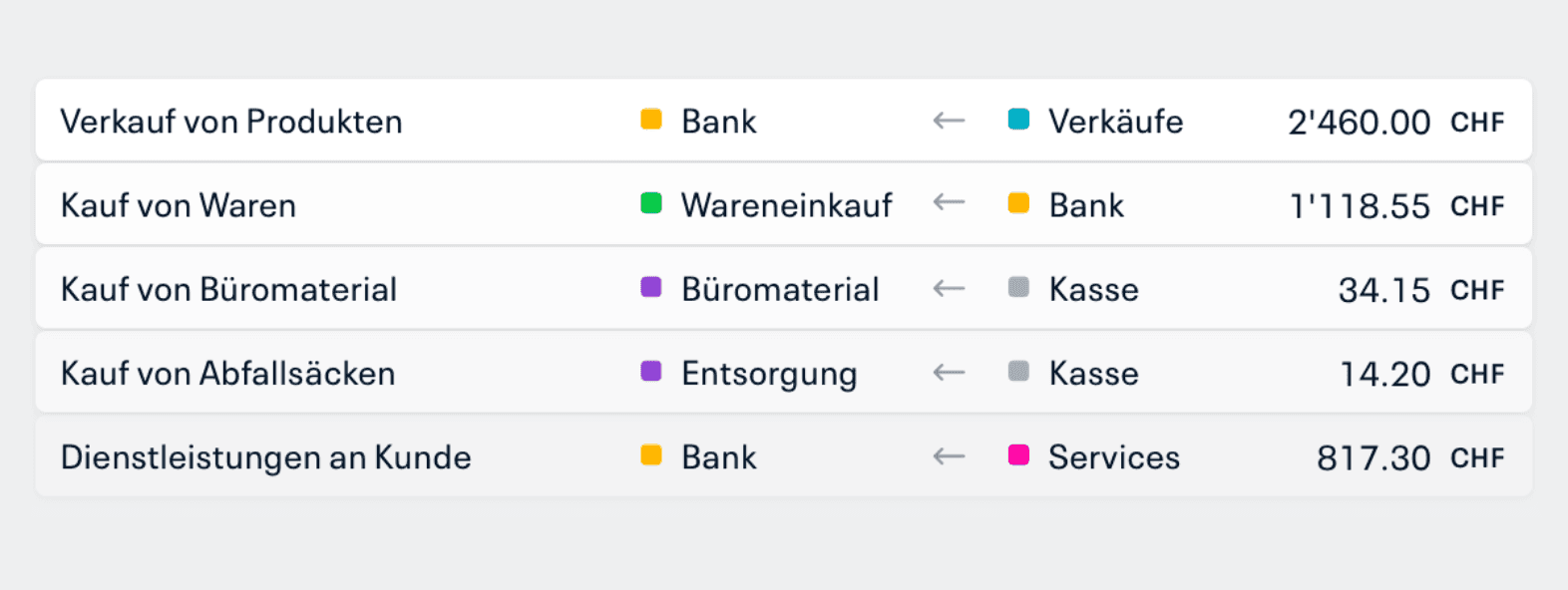
A payment for office supplies, for example, is recorded in these two accounts:
- Office supplies: an account to which all expenses in the office supplies category are booked.
- Cash: an account that represents the company's cash, which was used to pay for the purchase.
So on one side you record that new supplies have come in, and on the other that money has gone out. This way you always have the full picture and errors are easier to spot.
Debit and credit
In double-entry bookkeeping, every business transaction is booked to at least two accounts. One side of the transaction is recorded as a debit and the other as a credit.
- Debit: this is the "left side" of an account. Debit entries usually represent increases. For example, a bank account is debited when money comes in.
- Credit: this is the "right side" of an account. Credit entries usually represent decreases. So when you pay an invoice, your bank account is credited.
For liability and income accounts, it's the other way round – they increase on the credit side and decrease on the debit side.
Automated bookkeeping with accounting software
In modern accounting software such as Infinity Finance, debit and credit are handled automatically in the background.
The chart of accounts explained
Finances are represented using accounts. There are accounts for your business assets, such as your bank account, but also for liabilities, income and expenses.
Most Swiss accounting software uses the Swiss SME chart of accounts (Kontenrahmen KMU). It is the recommended standard chart of accounts for small businesses and founders.
View the official version of the Swiss SME chart of accounts (in German)
What types of accounts are there?
In accounting, accounts are divided into 4 basic types. Asset and liability accounts together make up the balance sheet, while expense and income accounts make up the income statement.
- Asset accounts: money and assets owned by your business, such as bank balances, inventory or property
- Liability accounts: debts you owe to third parties (e.g. bank loans) or to the owners (equity)
- Expense accounts: accounts used to record costs incurred, such as material purchases or rent
- Income accounts: accounts used to record income earned, such as proceeds from services or product sales
What are account numbers?
Some accounting software uses four-digit account numbers to refer to accounts.
- Accounts from 1000: asset accounts, e.g. your business bank account (1020), outstanding receivables (1100), but also various fixed assets such as machinery, vehicles or property.
- Accounts from 2000: liability accounts, which represent the company's debts to third parties or to its owners.
- Accounts from 3000: income accounts for your sales or the services you provide.
- Accounts from 4000: mostly expense accounts for costs incurred in your business (e.g. production costs, wages, rent) as well as the financial result.
- Accounts from 7000: income and expenses from ancillary operations
- Accounts from 8000: non-operating or extraordinary expenses and income
- Accounts from 9000: closing and opening accounts
You can look up these account numbers in the Swiss SME chart of accounts.
In Infinity Finance, you can choose whether or not you want to see account numbers.
Creating your own accounts
Depending on your business model, it can be worth creating specific income accounts, for example for your revenue streams. A manufacturing company might use several income accounts to analyse its revenue clearly:
- 3000 – Revenue from plastics production
- 3001 – Revenue from metalworking
- 3002 – Revenue from 3D printing
- 3003 – Revenue from textile production
The most important rule in accounting
The most important accounting rule is that the accounting equation always balances. In other words, the balance sheet total must always be the same on both sides:

The reason for this is double-entry bookkeeping: every booking affects both sides by the same amount.
If there is a difference between your assets and liabilities during the year, you still have unbooked profit or loss, which is then booked definitively at the end of your financial year.
Opening your accounts
At the start of the financial year, the books are opened. A special "Opening" account is used to book the opening balances into all your other accounts.
When you open your books, the accounting equation must balance, i.e. your assets and liabilities must be equal at the start.
A simple example:
If you start your business with, say, CHF 20'000 in share capital, you have to book these CHF 20'000 to the bank and also to the share capital liability account, because the company owes this money to its owner (this is called "equity").
Steps to set up your accounts in infinity.swiss
To get started with your accounts in Infinity Finance, start the free 14-day trial for your business.
- Then open your books in the "Bookings" tab using the "Start with opening balances" function.
- If needed, adapt the chart of accounts to your business, e.g. with separate income accounts for specific revenue streams.
- If you use a supported bank, you can also connect your bank account directly to Infinity Finance and get automatic booking suggestions powered by AI.
Balance sheet and income statement
Financial statements show how a business is doing. There are two key reports you need to know for your accounts: the balance sheet and the income statement.
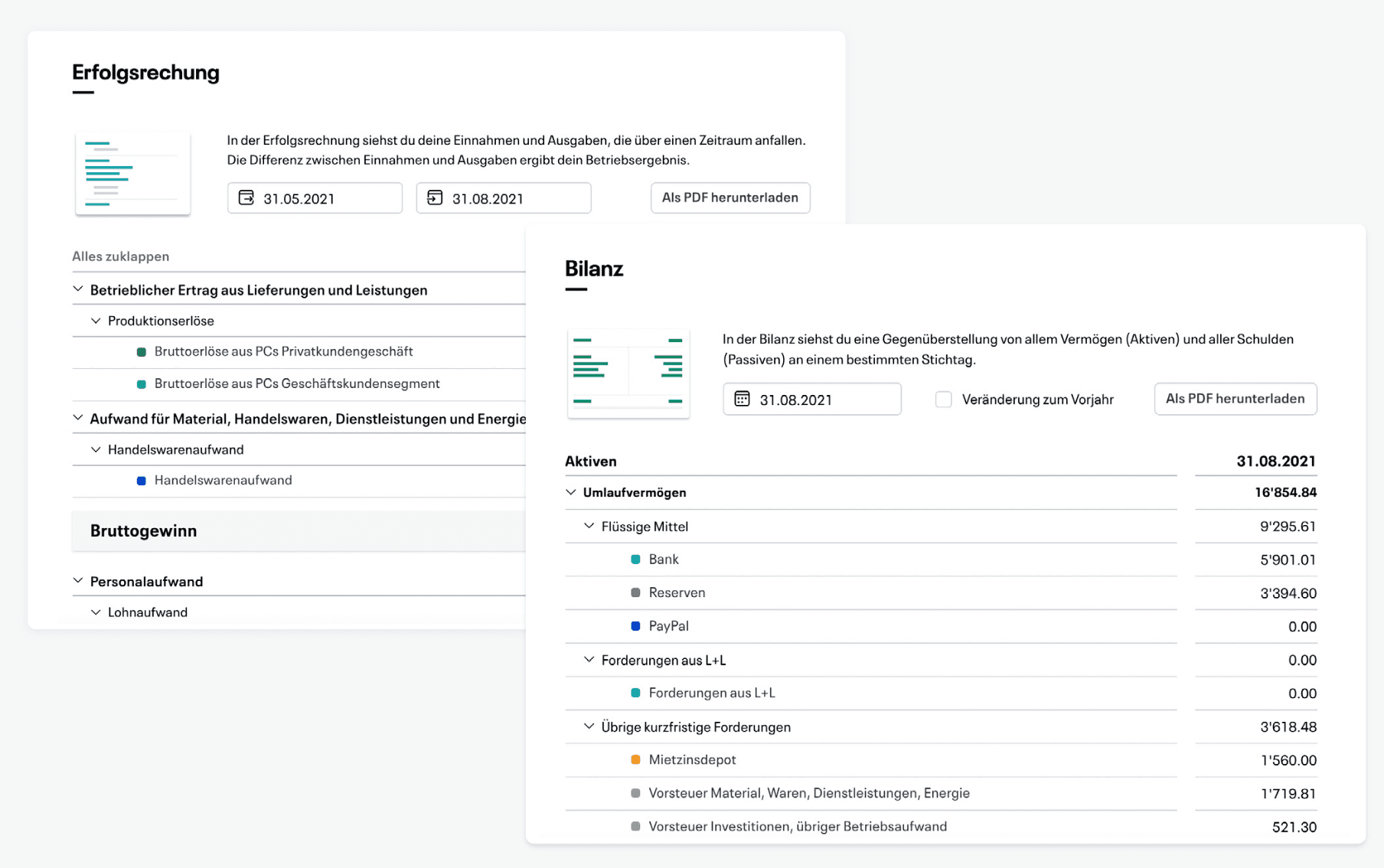
- The balance sheet is a snapshot of your business at a specific point in time. It shows how much your business owns and owes.
- The income statement shows changes over a specific period. It shows how much income and how many expenses your business had.
Both reports show your annual profit or loss. If the two don't match, something is wrong in your accounts.
At the end of the financial year, you prepare these statements once the financial year has been fully closed. They then form the basis for the next financial year and are relevant for your taxes.
In accounting software such as Infinity Finance, you can view a balance sheet or income statement at any time.
When do I need a fiduciary expert?
It's often worth consulting a fiduciary to review your accounts when you close the year.
Such a consultation is also worthwhile if you need to record something special in your accounts, e.g. crypto transactions, shareholdings, complex accruals and the like.
In Infinity Finance, you can invite your fiduciary expert free of charge to review your accounts. For preparing financial statements and tax advice, we recommend our fiduciary partner FINFINITY.
For day-to-day tasks with Infinity Finance, however, you no longer need a dedicated specialist. As a rule of thumb, hiring a full-time bookkeeper only becomes worthwhile from around 30 employees or revenue of more than a million.
More topics and links
Accounting basics
- Live Accounting
Live Accounting is a new kind of real-time accounting with AI that you can use in Infinity Finance - Invoicing software
If you want to send quotes and QR invoices, invoicing software such as Infinity Finance helps. - EasyGov
EasyGov is the government's simple online portal for setting up a business - Swiss SME chart of accounts
A standard chart of accounts that suits most businesses well – especially small businesses
Social insurance
- SECO guide for the self-employed (in German)
A useful overview from the State Secretariat for Economic Affairs of your obligations regarding AHV registration, VAT, etc. when you're self-employed - Overview of contributions and AHV contributions for the self-employed
On this official website, you can calculate your old-age and survivors' insurance (AHV) contributions online if you're self-employed. You'll also find useful fact sheets. - Cantonal compensation offices
A list of all cantonal compensation offices where you register as a self-employed person
VAT
- VAT registration
Online registration for mandatory VAT liability or voluntary VAT registration