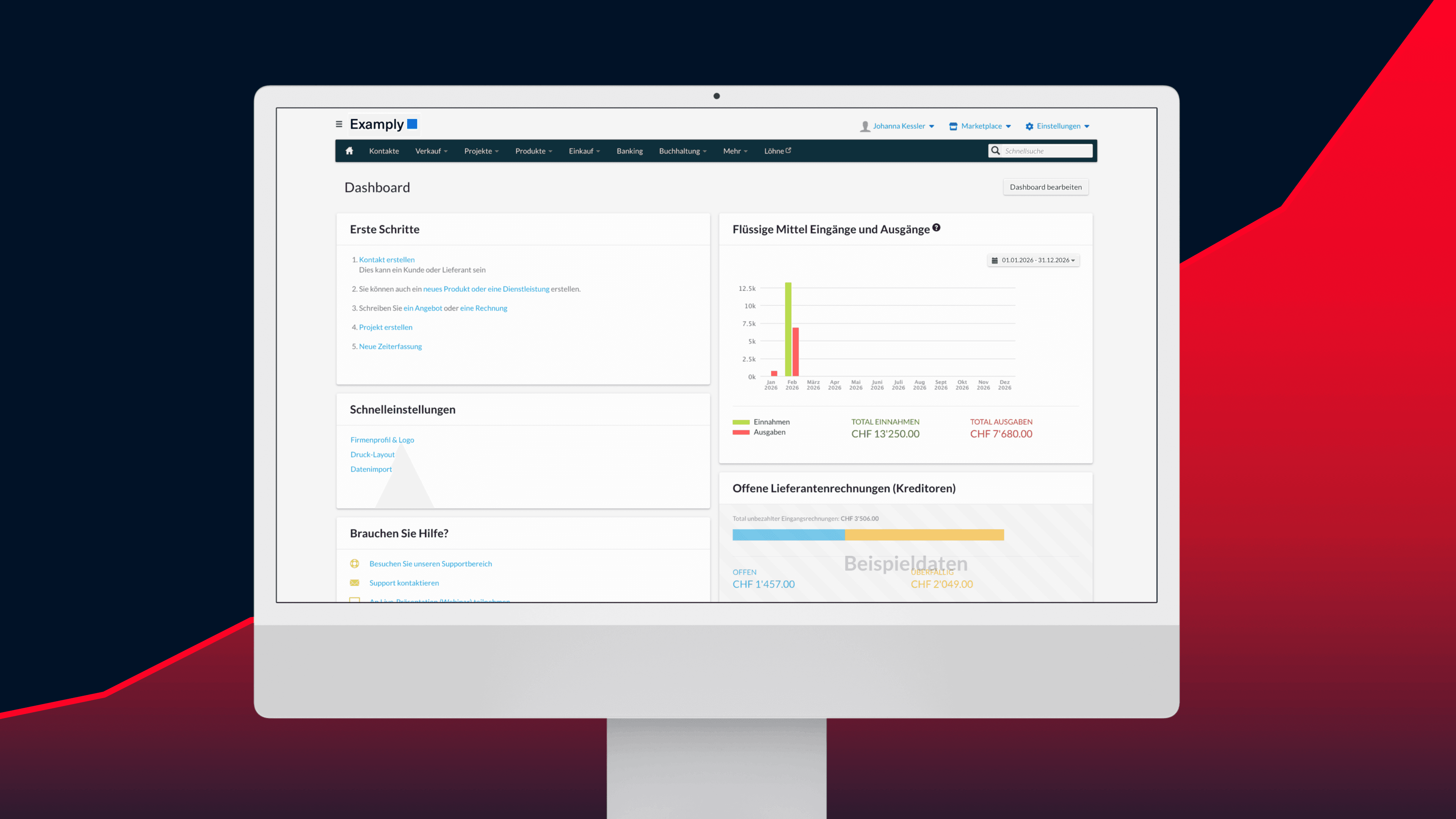
Many Swiss self-employed people and SMEs have been using bexio for their administration and accounting for years. But in March 2026, bexio fundamentally changed its pricing structure. According to the provider, new plan names, a new entry-level plan and higher prices for existing customers are meant to bring more flexibility.
In practice, though, the change mainly means one thing for many users: higher costs for the same features.
That's why freelancers, self-employed people and smaller companies in particular should take a closer look. What exactly are the new bexio prices for 2026, what happens to existing subscriptions – and are there more modern alternatives by now?
This article explains the changes in plain terms and shows what bexio customers should watch out for now.
The new bexio prices for 2026 at a glance
In March 2026, bexio replaced its previous plans Starter, Pro and Pro+. In their place is a new plan structure with Basic, Advanced, Optima and Ultimate.
The key point: the former entry-level plan has effectively become more expensive.
The previous Starter plan at CHF 35 per month has been replaced by a new plan – Basic. However, the new Basic plan at CHF 35 is not comparable with the Starter plan and offers a much smaller set of features. Existing customers who were on Starter until now are therefore automatically moved to the equivalent new Advanced plan at CHF 42 per month – which amounts to a price increase of around 20%.
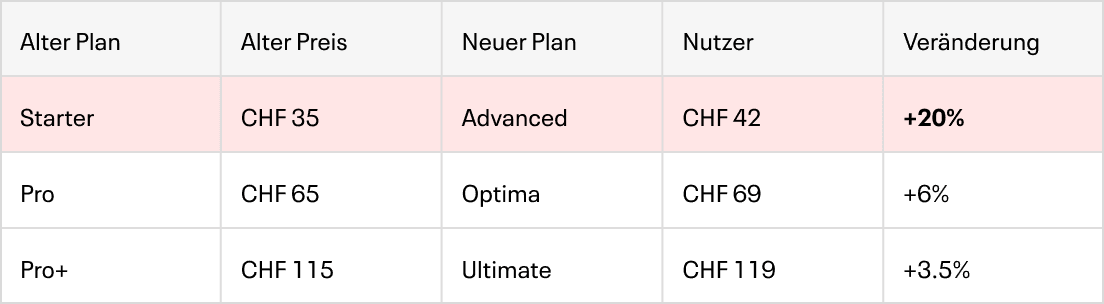
The new Basic plan at CHF 35 per month is cheaper, but it contains considerably fewer features.
This creates a situation typical of many SaaS price changes:
a cheaper plan does exist – but many of the core features are only included in the more expensive plan.
What's included in the new Basic plan – and what's missing?
At first glance, the new Basic plan sounds attractive because it's priced similarly to the old Starter plan. Its feature set, however, is considerably reduced.
Several features that used to be included in the entry-level plan are now missing or have been moved to higher plans.
– Bank connection and automatic bank reconciliation
For many companies, this is one of the most important parts of modern accounting software. Yet it isn't included in the new Basic plan. If you want to import bank transactions automatically, you need at least the Advanced plan.
– Expenses and supplier invoices
Processing expenses and incoming invoices is also restricted in the Basic plan and only fully available in higher plans.
– Time tracking and project features
These are still only available in more expensive plans.
In short: if you want to use what many people used in the Starter plan until now, you'll practically automatically end up on the Advanced plan for around CHF 42 per month.
What happens to existing bexio customers?
One of the most common questions about the 2026 bexio price increase concerns existing users.
The answer is fairly simple: the previous plans are automatically switched to the new plans.
In concrete terms, this means:
- Existing Starter customers are automatically migrated to Advanced
- The price therefore rises from CHF 35 to around CHF 42 per month at the next renewal
- If you want to switch to the new Basic plan, you have to downgrade actively – but you then lose features
That's why many companies only notice the change with their next bill.
Why many users are critical of the new prices
Price adjustments are nothing unusual in SaaS. Software evolves, costs rise and new features are added.
The main criticism of bexio's 2026 prices is a different one, though: for many users, the feature set has barely changed while the price has gone up.
Especially for self-employed people or small companies that mainly need to:
- write invoices
- book bank transactions
- record receipts
- file VAT returns
the new structure often means they pay more than before – without any clear added value.
The technology question: where does bexio stand today?
Another point that's being discussed more and more is the technological progress of accounting software.
Many modern tools now rely heavily on AI-powered automation. This isn't just about reading receipts, but about entire workflows:
- automatic booking suggestions
- smart matching of transactions
- automatic matching of invoices to bank transactions
- continuous improvement
In bexio, such features are missing or only available to a limited extent.
Receipt scanning, for example, is mainly available through the mobile app and is limited in many cases. At the same time, core workflows such as booking bank transactions lack AI automation.
This means bookings still have to be created manually.
Modern alternatives to bexio
This is exactly why many companies are currently comparing alternatives. Especially since bexio's 2026 price change, the question has shifted from "Which software has the most customers?" to "Which software really saves me time?". Modern accounting systems increasingly rely on automation and AI workflows to cut down on repetitive tasks. One of the platforms frequently mentioned in this context is Infinity.
Infinity as a modern bexio alternative
Many accounting programs have grown over time. They were originally built to map traditional accounting processes digitally – not to automate them fundamentally.
Infinity takes a different approach. The platform was developed from the start as AI-native accounting software. The goal isn't just to make accounting available in the cloud, but to automate as many of the manual steps as possible.
The difference is particularly clear in the areas that take up the most time in day-to-day work.
Automatic booking of bank transactions
With Infinity, bank transactions aren't just imported – they're analysed directly with AI and booked automatically. The software recognises patterns, suggests suitable account assignments and keeps learning from previous bookings. This produces booking suggestions that keep improving over time and significantly reduce manual work.
AI-powered receipt recognition
Receipts and invoices can be uploaded directly to Infinity or imported by email. Their contents are recognised automatically, read in a structured way and matched with the corresponding bank transactions. As a result, many bookings practically create themselves – without every invoice having to be entered manually.
Fast product development
Another difference lies in the pace of development. While many traditional tools have barely changed their core products over the years, Infinity keeps evolving. New features, automations and improvements are released continuously – with the aim of making accounting simpler and more efficient step by step.
Price comparison: Infinity vs. bexio
There's a clear difference in price, too.
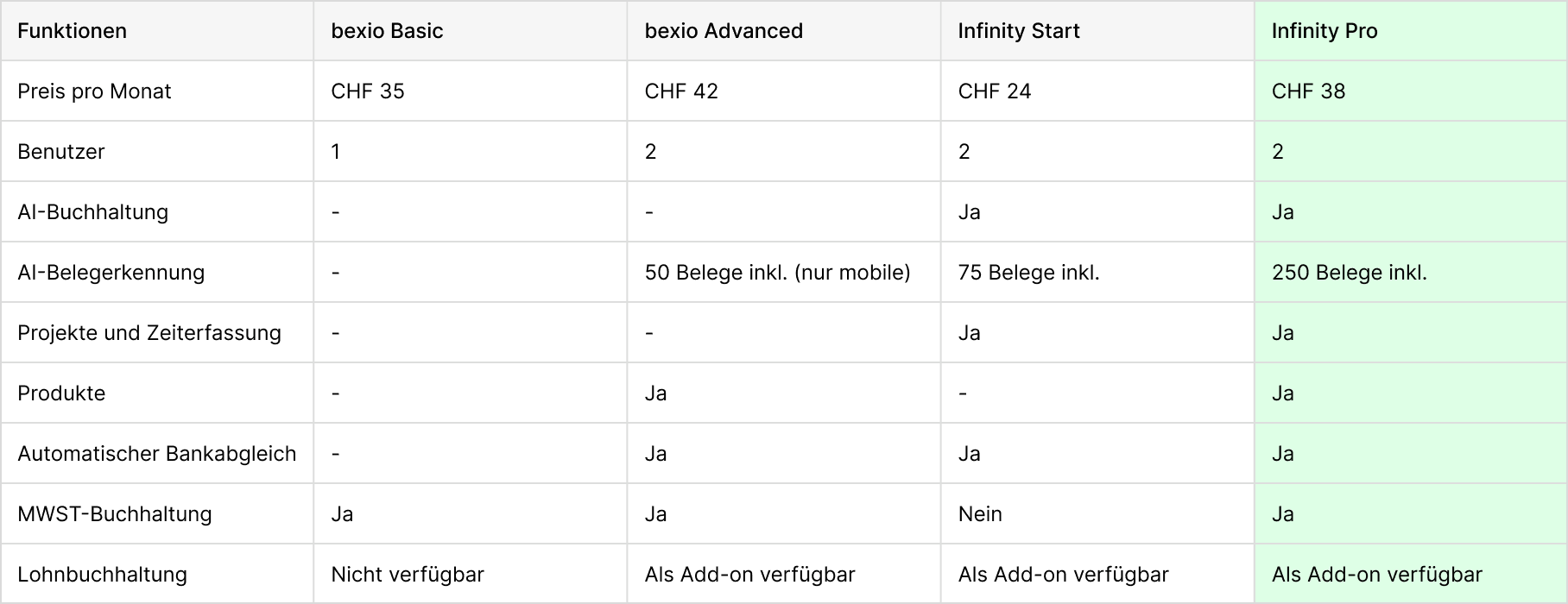
With the new plan structure, many bexio customers now pay around CHF 42 to CHF 69 per month, depending on the features they need.
Infinity costs considerably less for comparable features and offers more automation at the same time.
For many self-employed people and smaller companies, this means:
- lower software costs
- less manual booking work
- a more modern platform
Is bexio still worth it in 2026?
bexio remains a well-known and solid solution for many Swiss SMEs. The platform is established, has a large user base and a broad ecosystem.
However, bexio's new 2026 prices have led many companies to question their choice of software again.
Self-employed people, freelancers and small teams in particular are increasingly asking themselves three questions:
- Am I paying for features I don't even need?
- Are there cheaper solutions with the same core features?
- Is there software that really saves me time thanks to AI?
Depending on your situation, switching can therefore make sense.
Conclusion
bexio's 2026 price change mainly affects the platform's entry level. Many existing users will pay more for the same features in future, while the new Basic plan drops important features.
For many self-employed people and small companies, now is therefore a good time to re-evaluate their accounting software. Modern solutions such as Infinity show where the market is heading: automated accounting, AI-powered workflows and continuous product innovation. So if you're choosing accounting software today, don't just compare prices – above all, ask yourself: how much work does the software really take off my hands?