
Alongside the balance sheet, the income statement – known in many countries as the profit and loss statement – is one of the most important reports in double-entry bookkeeping. But how do you prepare and interpret an income statement correctly under the Swiss Code of Obligations (OR)?
What is an income statement?
The income statement shows a company's expenses and income over a specific period. The difference between expenses and income is the profit or loss.
Note: "Erfolgsrechnung" (income statement) is the usual term in Switzerland, while other countries often speak of a profit and loss statement (P&L). It is the same thing.
Difference between the balance sheet and the income statement
The balance sheet and the income statement are the two most important reports in double-entry bookkeeping:
- The balance sheet shows assets and liabilities at a specific point in time.
- The income statement shows expenses and income over a specific period.
Both reports show the company's profit or loss, and the two figures must match for the accounts to be correct.
The balance sheet is therefore a snapshot at the end of a given period, usually at year-end. The income statement, by contrast, is like a film that shows how the company performed over a period, usually a financial year.
How an income statement is structured
The income statement is a list of expense and income accounts, organised into standardised subgroups and subtotals.
Requirements for an income statement under the OR
Under Art. 959b OR and the principles of proper financial reporting in Art. 958 OR, the following requirements must be met:
- Clear structure and order: items must be presented in the order prescribed by law.
- Items shown separately: as a rule, items must not be offset against each other (gross principle).
- Accrual basis: income and expenses must be allocated to the correct period (e.g. advance payments for work not yet performed, or expenses already paid for services only provided the following year, must be deferred).
- Additional disclosure: where material for third parties, further items must be shown separately in the income statement or in the notes. With the cost-of-sales format in particular, personnel expenses and depreciation/value adjustments must additionally be shown in the notes.
Layout of the income statement
An income statement using the nature-of-expense method (a so-called "production income statement"), which is common among Swiss SMEs, must be structured as follows:
- Net proceeds from sales of goods and services
- Change in inventories of unfinished and finished goods and in unbilled services
- Material expenses
- Personnel expenses
- Other operating expenses
- Depreciation and value adjustments on fixed assets
- Financial expenses and financial income
- Non-operating expenses and non-operating income
- Extraordinary, one-off or prior-period expenses and income
- Direct taxes
- Annual profit or annual loss
Do I have to list every item?
Under Art. 958d OR, items in the income statement with no value or an insignificant value do not have to be listed separately.
Single-step vs. multi-step income statement
In Swiss accounting, there are basically two types of income statement: the single-step and the multi-step income statement.
While the single-step income statement is suitable for a quick overview, the multi-step version allows a deeper, more precise analysis of business results.
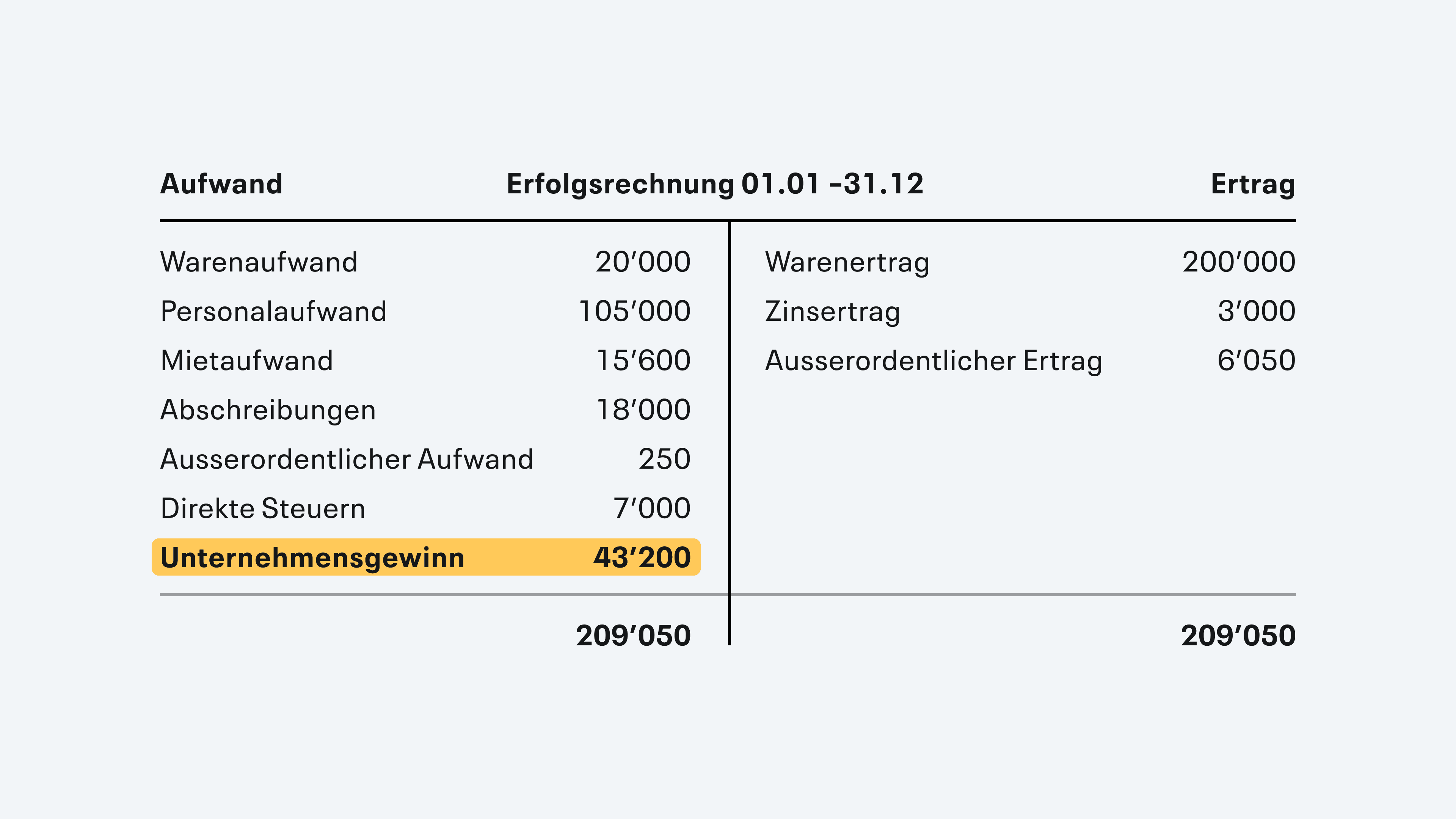
Single-step income statement
The single-step income statement is the simplest way of calculating profit. All income is added up and all expenses are deducted from it. The result is the profit or loss. This version gives a quick overview but little detail about where the profit comes from.
Multi-step income statement
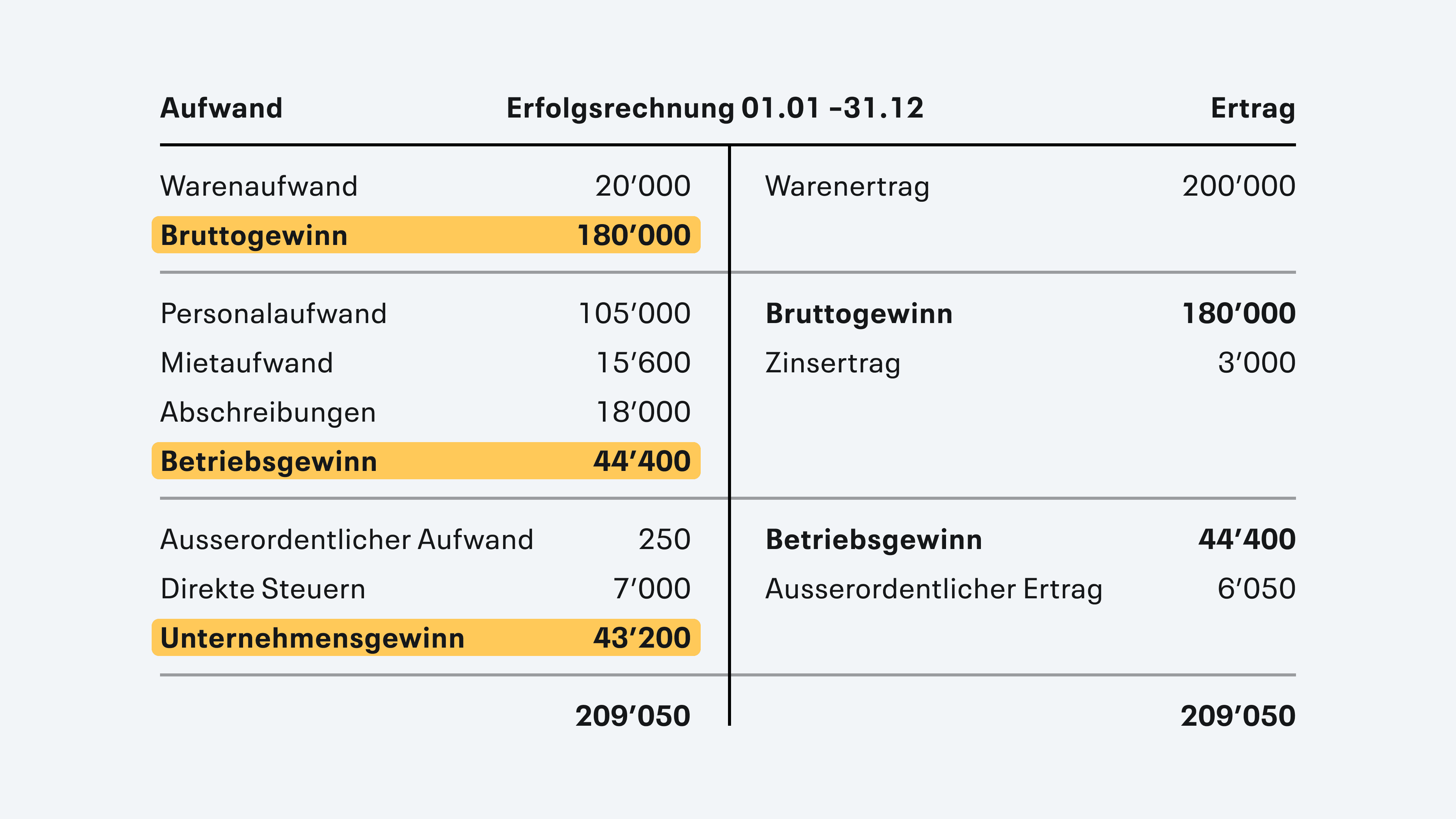
The multi-step income statement, by contrast, breaks the result down into several steps. This gives a more detailed picture of a company's financial situation:
- Gross profit: revenue (income) minus direct costs (such as cost of goods)
- Operating profit (EBIT): gross profit minus operating expenses (e.g. staff, rent, marketing)
- Company profit: operating profit minus non-operating expenses and income (such as interest, property income or taxes)
The multi-step income statement offers more transparency and makes it possible to pinpoint weaknesses and strengths. This gives companies valuable information for improving their operating result.
Types of expenses and income
There are various categories of expenses and income that you should keep in mind. You can use the Swiss SME chart of accounts as a guide for the structure. In Swiss accounting software, the structure of this chart of accounts is set up automatically.
Main types of expenses
- Material expenses: these relate to the purchase of raw materials, supplies and consumables needed for production.
- Personnel expenses: these include employees' salaries and wages and all related social security costs.
- Depreciation: depreciation records the loss in value of fixed assets, such as machinery or buildings, over their useful life.
- Operating expenses: this covers all running costs, such as rent, energy and insurance.
Types of income at a glance
- Operating income: this category covers all revenue generated by the main business activity, such as selling products or services.
- Interest income: income from interest that the company earns on investments or loans.
- Other income: this heading can include all other income not directly related to the main business activities, such as one-off proceeds from selling fixed assets.
How to read an income statement
Reading the income statement gives you an overview of the company's income and expenses and lets you draw conclusions about the profitability and efficiency of its business activities.
- At the top of the income statement, you'll find the revenue the company generated in the period.
- Costs such as materials, wages and other operating costs are then deducted from it. This is where you can see how high the expenses are.
- The subtotals "gross profit", "operating profit (EBIT)" and "EBITDA" show you how profitable the operating business is and let you compare it across periods.
- At the bottom of the income statement, you'll find the net profit or loss for the period.
Another relevant point is the comparison with previous periods or industry benchmarks. This can help you assess the company's performance objectively.
You should also pay particular attention to exceptional items, as they can affect the result but will not necessarily recur in future.
How do I prepare an income statement?
Step-by-step guide
Here we walk you through the key steps for preparing a complete, error-free income statement.
- Start by gathering all relevant documents: collect all receipts and documents relating to income and expenses. These include invoices, receipts, bank statements and contracts. Every document can matter, so don't leave anything out.
- Categorise your income and expenses: assign income and expenses to their respective categories. Every item should be allocated correctly to avoid corrections later.
- Work out your revenue: add up all sales proceeds and other income to determine total revenue. This total is the basis for all further calculations, so make sure you don't miss any income.
- Determine total costs: add up all expenses needed to generate the revenue. These include material costs, wages, rent and other operating expenses. Accurate recording ensures precise results.
- Calculate gross profit: deduct total costs from income to arrive at gross profit. This figure shows you at a glance how profitable your business is.
- Take depreciation and interest into account: list all other operating income and expenses, such as depreciation or interest, to arrive at the operating result.
- Create the final layout of the income statement: put all the information you've gathered into a clear, easy-to-follow format.
- Review and check: finally, check all figures carefully for accuracy and completeness. Comparing with the balance sheet to see whether the profit or loss matches is particularly useful here.
Accounting software for the income statement
Modern accounting software creates your income statement automatically and without errors. With infinity.swiss, you get not just a simple income statement but a detailed multi-step view that gives you valuable insight into how your business is performing.
Benefits of an automated income statement:
- Saves time: no more manual calculations
- Fewer errors: automatic booking reduces calculation mistakes
- Always available: call up the current income statement with a single click
- Swiss compliance: OR requirements are met automatically
- Easy comparisons: compare different periods in no time
With infinity.swiss, you can generate an up-to-date income statement for any period and download it directly as a PDF – ideal for interim closings or quick ad-hoc analyses.
What an income statement looks like in infinity.swiss
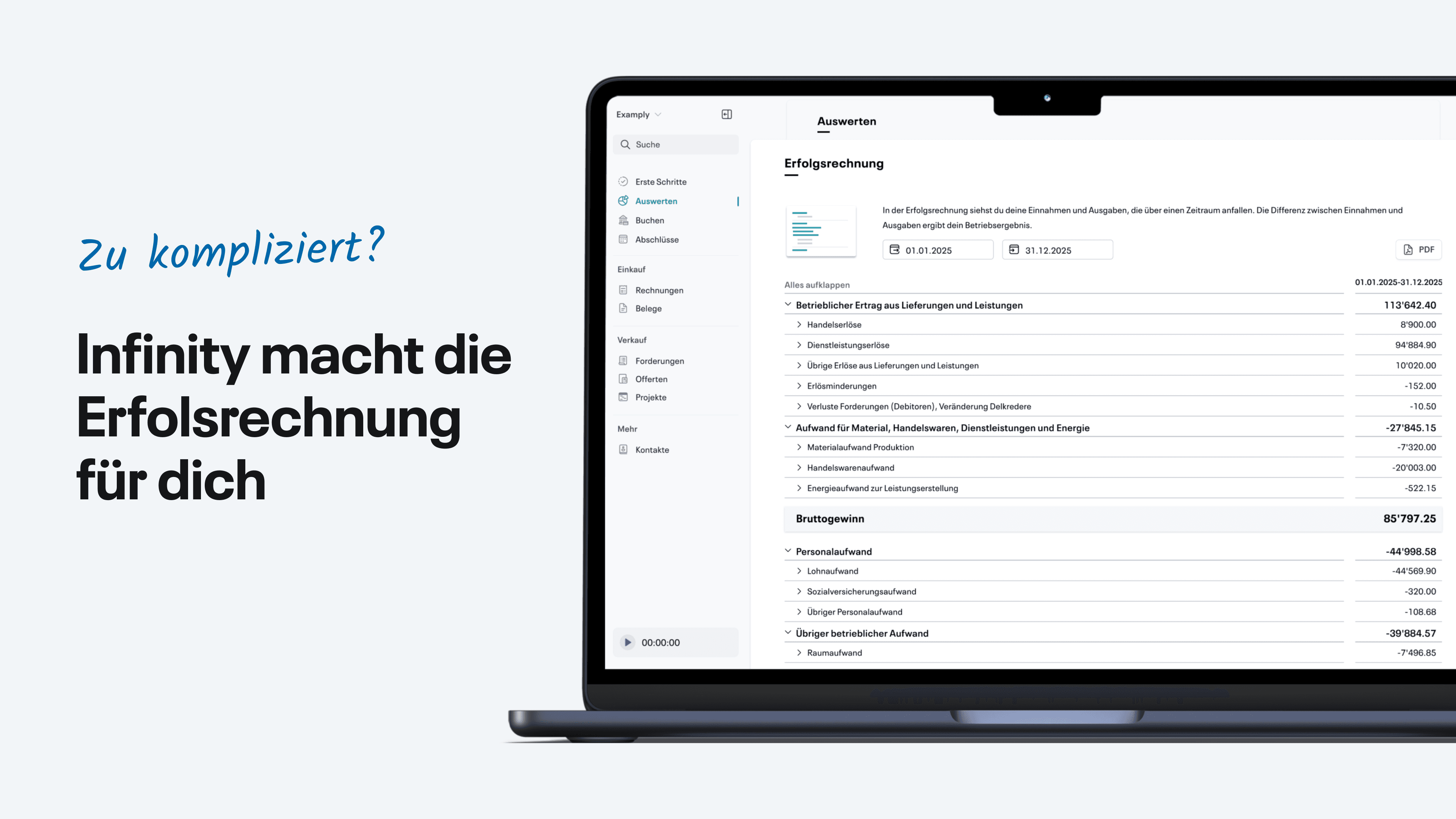
The screenshot shows the user-friendly interface of infinity.swiss displaying a multi-step income statement. You can see all the key elements at a glance:
- Flexible periods: use the date fields to select any period – from the monthly to the annual closing
- Multi-step structure: the income statement clearly shows the path from revenue via gross profit and EBITDA to net profit
- Expandable items: each main category can be expanded when needed to see the detailed bookings
- Instant PDF export: one click on "PDF" gives you a professionally formatted income statement for authorities or business partners
- Automatic calculation: all subtotals and key figures are calculated automatically – calculation errors are a thing of the past
Particularly handy: you can call up the income statement at any time and don't have to wait until year-end. That way, you keep track of how your business is developing all year round.
Three practical examples from different industries
Freelance agency without inventory: in service businesses, material expenses are usually low – the focus is on personnel costs and operating expenses. This makes it especially easy to measure operational efficiency, as the EBITDA margin is often above 30%.
E-commerce shop: cost of goods and shipping dominate the cost structure. Changes in inventory have a direct impact on gross profit and must be recorded cleanly. Here, the gross profit margin is a key measure of success.
SaaS start-up: material expenses play a minor role, while development and marketing costs are usually high. It's important here to distinguish between EBITDA and actual cash flow, as the two can differ considerably.
These examples show how different income statements can look depending on the industry. With modern accounting software such as infinity.swiss, you automatically get the key figures relevant to your industry and can monitor your performance closely.
Key figures in the income statement
Revenue
Revenue comprises all of a company's income from selling goods and services within a given period. It is the starting point of the income statement.
Gross profit
Gross profit is revenue minus direct production costs (cost of goods and materials). It shows the earning power of the core business without taking into account fixed costs such as rent, IT expenses, wages, etc.
Operating result (EBITDA)
EBITDA (earnings before interest, taxes, depreciation and amortisation) measures operating profit before interest, taxes, depreciation of tangible assets and amortisation of intangible assets. It makes it possible to compare profitability between companies in different industries and with different levels of investment.
"Amortisation" vs. "Amortisierung" in EBITDA
Note: the English word "amortisation" in the EBITDA abbreviation refers to the write-down of intangible assets and has nothing to do with the German term "Amortisierung", with which it is often confused and which describes the repayment of a financial debt.
EBIT
EBIT (earnings before interest and taxes) measures operating profit after depreciation and amortisation but before interest and taxes. It is a key indicator of a company's operating performance and earning power.
Net profit
Net profit (or net loss if negative), often also called the net result, is the final result left over after deducting all expenses, costs and taxes from a company's income.
In double-entry bookkeeping, the net profit in the income statement must match the one in the balance sheet – otherwise an error has crept into the accounts.
Frequently asked questions about the income statement
Do I have to prepare an income statement?
Under the Swiss Code of Obligations (OR), the following businesses must prepare an income statement:
- Companies limited by shares (AG)
- Limited liability companies (GmbH)
- Cooperatives
- Sole proprietorships or general partnerships with annual revenue of more than CHF 500'000
Even for sole proprietorships below this threshold, keeping proper double-entry books can be worthwhile – for better analyses, simpler VAT returns and more certainty in the tax closing.
With double-entry accounting software such as infinity.swiss, you can then generate an income statement automatically with a single click, even without prior knowledge.
When does an income statement have to be prepared?
Ideally, an income statement should be prepared once a year at the end of the financial year.
Ideally, you also check the current state of expenses and income more often during the year – automated accounting software is useful here, as it lets you call up an income statement at any time with one click.
What period does the income statement cover?
The income statement is usually prepared for a full financial year.
In accounting software, however, you can also create an income statement for any other period, such as a particular quarter, in just a few clicks. This can be helpful, for example, when comparing seasonal sales quarters.
What happens if my income statement shows a loss?
A negative result in the income statement means that expenses exceed income, resulting in a loss.
If you have a net loss in the income statement, you must offset it against your equity at the end of the financial year via the "annual profit or loss" account.
For start-ups and young companies in particular, however, it's common not to make a profit in the first few years – such losses can then be offset against taxable profit for 7 years. In the long run, though, losses must not be ignored even when liquidity is good, so that the company remains viable.