Value added tax applies to your purchases, sales and services. It comes into play whenever you issue invoices and receivables. Make sure you apply the VAT rates correctly and show VAT on your invoices.
Complying with the VAT rules matters, because it is what keeps you out of trouble with the tax authorities.
What is value added tax?
Value added tax (VAT) is one of the most important indirect taxes in Switzerland. It rests on the idea that the end consumer contributes to the federal budget whenever they consume something.
To keep this practical, the tax is collected by businesses instead: manufacturers, retailers, service providers and so on. Those businesses either include VAT in the sale price or show it separately on the invoice. In the end, VAT is collected from the consumer and passed on to the state.
Why do companies have to pay VAT?
A common misunderstanding is that VAT is meant to tax businesses. The idea behind VAT is that the burden falls on consumers. Companies simply collect it from the consumer and hand it over to the state.
VAT liability in Switzerland
In principle you are liable for VAT if you independently pursue a professional or commercial activity and appear externally under your own name, whether that is your personal name or a company name. This applies even if you are not entered in the commercial register.
Which turnover actually counts towards the threshold, when exactly liability begins and how registration works is covered in the article on VAT liability in Switzerland.
Who is exempt from VAT liability?
Up to CHF 100,000 of annual turnover, in Switzerland and abroad, you are still exempt from this liability. For voluntary-run sports and cultural associations and for non-profit institutions, that threshold is CHF 250,000.
If you are still exempt because of your turnover, it is advisable to state this explicitly on your invoice, so the recipient does not try to claim an input tax deduction they are not entitled to.
Voluntary VAT registration
You can also subject yourself to VAT voluntarily. That means you tax your turnover even though you have not yet reached the thresholds.
Voluntary registration tends to pay off in these cases:
- If you make large investments and want to recover the VAT you paid, for example on expensive film equipment
- If you sell mainly to businesses rather than private individuals
- If you export a lot of goods from Switzerland
- If you buy a lot of services from abroad, which raises the topic of acquisition tax
What is the input tax deduction?
The input tax deduction lets you deduct the Swiss VAT you paid on purchases of goods and services from your own VAT liability.
This mechanism avoids double taxation and lowers your effective tax burden.
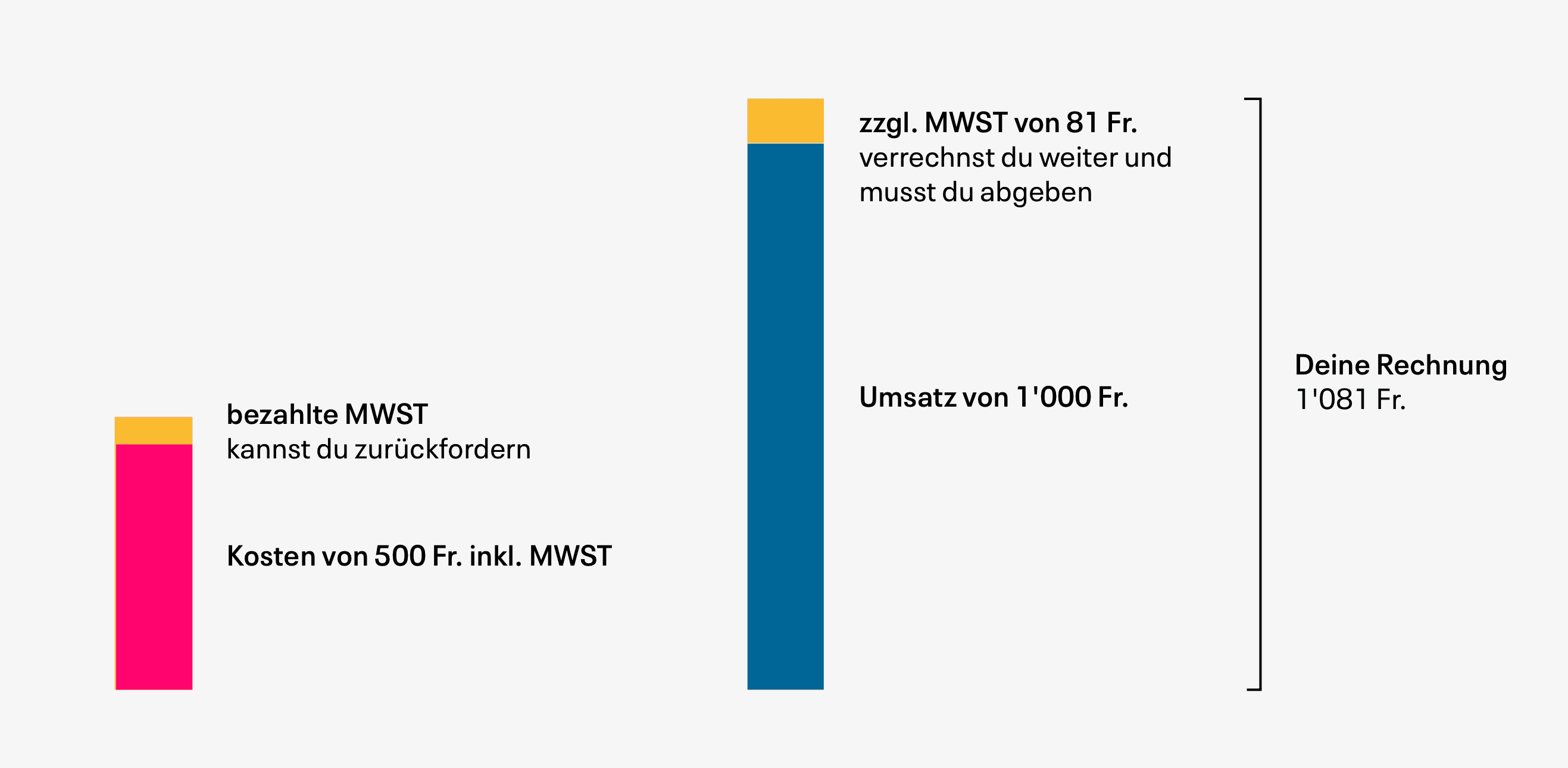
In other words, you get back the money you paid in VAT and only pay the difference to the tax administration. That avoids double taxation and reduces your effective tax burden.
If you paid more input tax in a tax period than you owe in VAT on your turnover, the tax administration will even issue you a credit.
Current VAT rates in Switzerland
Switzerland has three different VAT rates, which according to the FTA have applied since 1 January 2024:
- Standard rate (8.1%): taxable domestic income
- Accommodation rate (3.8%): income from providing accommodation, including any breakfast that goes with it
- Reduced rate (2.6%): income from supplies such as certain foodstuffs, newspapers, books and similar
This is a political choice: for certain services, such as hotels, foodstuffs or medicines, lower taxation is intended.
You will find a full list of the reduced-rate supplies on the official page of the Federal Tax Administration, which is available in German.
Showing VAT net or gross
There are different ways to charge VAT-liable turnover on your receivables:
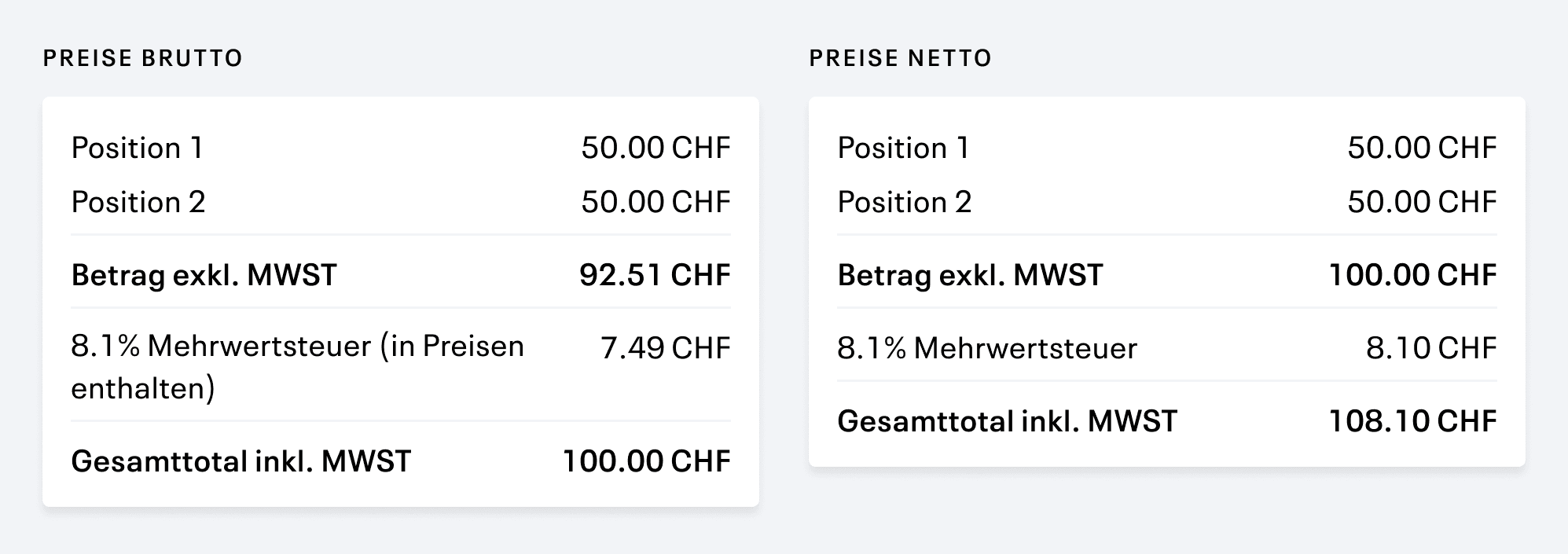
- Net amounts: VAT is added on top of your prices.
- Gross amounts: VAT is already included in your prices.
Quoting net prices is particularly common when you sell to companies, because businesses can reclaim the VAT and therefore only carry the net cost.
Registering for VAT
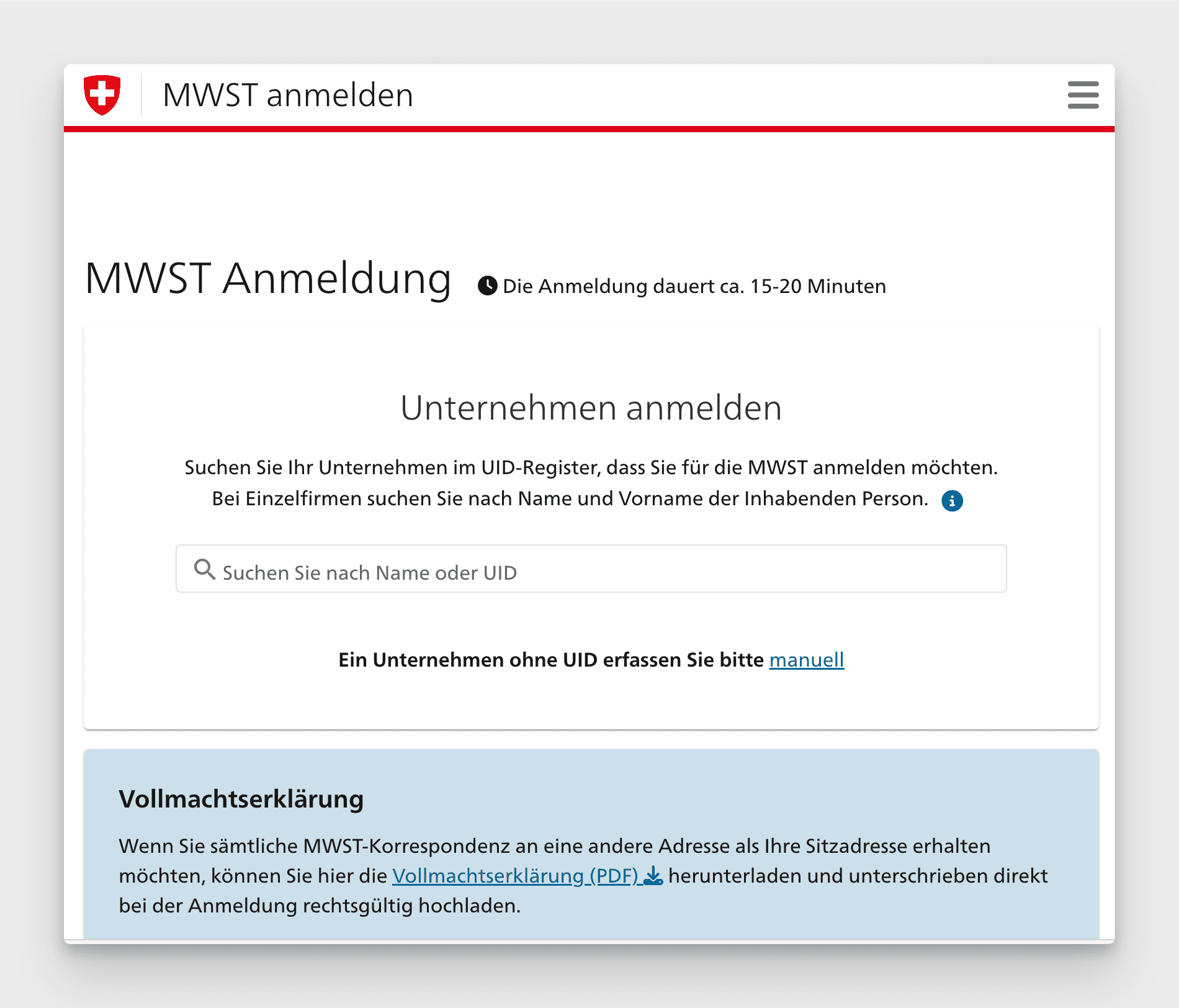
You can complete your VAT registration online on the website of the Federal Tax Administration FTA, even if you have no entry in the commercial register. In that case, choose the option in the online tool for entering your company details manually.
Note that an online-only requirement has applied since 1 January 2025, so it is no longer possible to submit the VAT form on paper.
Financial year at registration
For the financial year, the calendar year is advisable in most cases, possibly with a shortened first year running to 31 December if you started trading part-way through the year.
Net tax rate or effective method
Up to CHF 5,024,000 of annual turnover and a tax burden of no more than CHF 108,000 per year, you can apply for the simplified net tax rate method (Art. 37 VAT Act). You then multiply your gross turnover including tax by an industry-specific rate that the FTA approves for you.
The net tax rate does not estimate your tax burden. It reflects the input tax ratio typical for your industry as a flat rate: you no longer deduct your input tax item by item, because it is already accounted for in the rate. On your invoices you still show the normal rates.
However, this can lead to a higher tax burden, and you cannot benefit from credits for your actual input tax if you start out with many expenses and little income.
If you work with accounting software, we therefore recommend the ordinary VAT return, because modern tools make the effective method largely automatic.
Which method is cheaper for you depends above all on the size of your input costs. You will find a worked example of both variants in the article on the net tax rate or the effective method.
Agreed vs. collected consideration
Accounting on the basis of agreed consideration is more common and requires fewer corrections if you work with accounting software.
Filing VAT returns
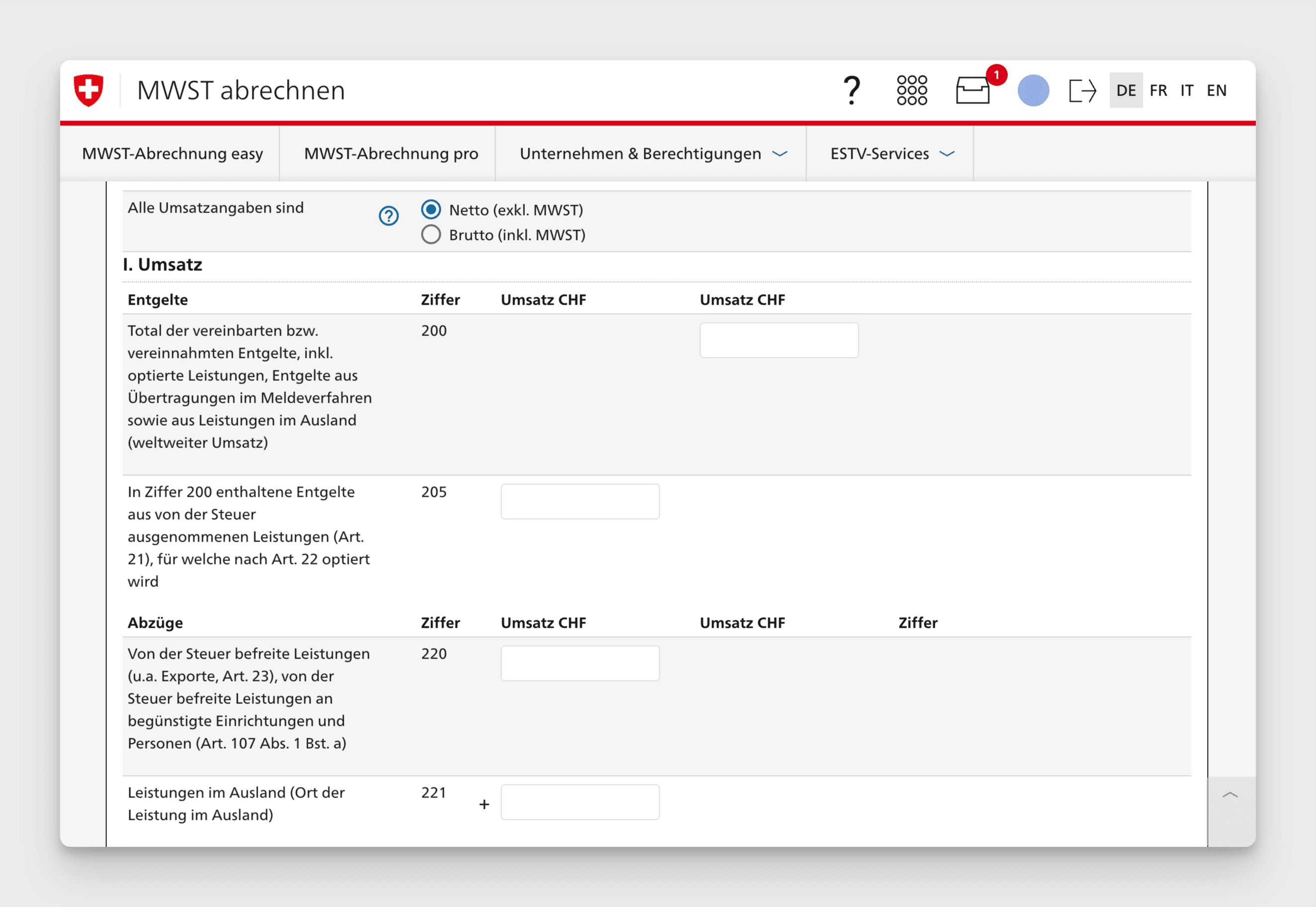
You will usually file your VAT returns quarterly in the tax administration's portal. You are given access there after registering. Since 2025, paper returns are no longer accepted.
VAT deadlines: when the return is due
VAT is a self-assessed tax: the FTA does not send you a bill and does not remind you. You have to file the return without being asked within 60 days of the end of the reporting period (Art. 71 para. 1 VAT Act) and pay the amount owed within the same deadline (Art. 86 para. 1 VAT Act). Filing and paying are not two dates, but one.
With quarterly returns that gives you four deadlines a year. In its own example, the FTA names 31 May as the due date for the first quarter, on a page available in German.
VAT deadlines through the year
The basis is the 60-day deadline after the end of the reporting period (Art. 71 and Art. 86 VAT Act). What is binding is always the due date the FTA shows you in the portal for the specific period.
The return for the fourth quarter therefore falls into the following year, right in the middle of the annual closing – which is the deadline that most often slips in practice. How filing in the FTA portal works in detail, and what a deadline extension actually buys you, is covered in the article on VAT deadlines and the FTA portal.
Annual return: one instead of four
Since 1 January 2025 you can file your VAT annually on request, provided your annual turnover does not exceed CHF 5,005,000. Instead of four returns a year, you file one.
You apply through the FTA portal, at the latest 60 days after the start of the tax period – with a calendar financial year, that means by the end of February. The return itself has to be filed by the end of February of the following year and paid by then too.
There is something in return: the annual return is tied to instalment payments set by the FTA. Under the effective method and the flat tax rate method three instalments are due, on 30 May, 30 August and 30 November. Under the net tax rate method there is a single instalment on 30 August. The conditions and the instalment amounts are set out by the FTA on a page available in German; when the switch pays off is covered in the article on the annual VAT return.
Whatever your reporting frequency, one final step follows at the end of the financial year: you have to reconcile the returns you filed against your annual closing and correct any discrepancies you find. How this annual VAT reconciliation works and which deadlines apply is covered in its own article.
Modern accounting tools help you get your VAT done faster. Infinity, the AI accounting software of Switzerland, connects to your bank account and proposes bookings in real time with Live Accounting, while Live Capture reads receipts from a photo. That way the figures for your return are ready when the deadline comes, instead of having to be reconstructed the night before.
Further information
You will find more information in VAT Info 19 published by the Federal Tax Administration, which is available in German.