Anyone providing goods or services in Switzerland will sooner or later issue an invoice. It sounds straightforward, but an incorrect invoice can lead to questions from the recipient, prevent input VAT deductions, and, in the worst case, end up in the “not deductible” pile during a VAT audit. This guide covers everything: from the legally required information and the QR invoice as the Swiss standard to what happens when a customer does not pay.
Writing an invoice in Switzerland: mandatory information
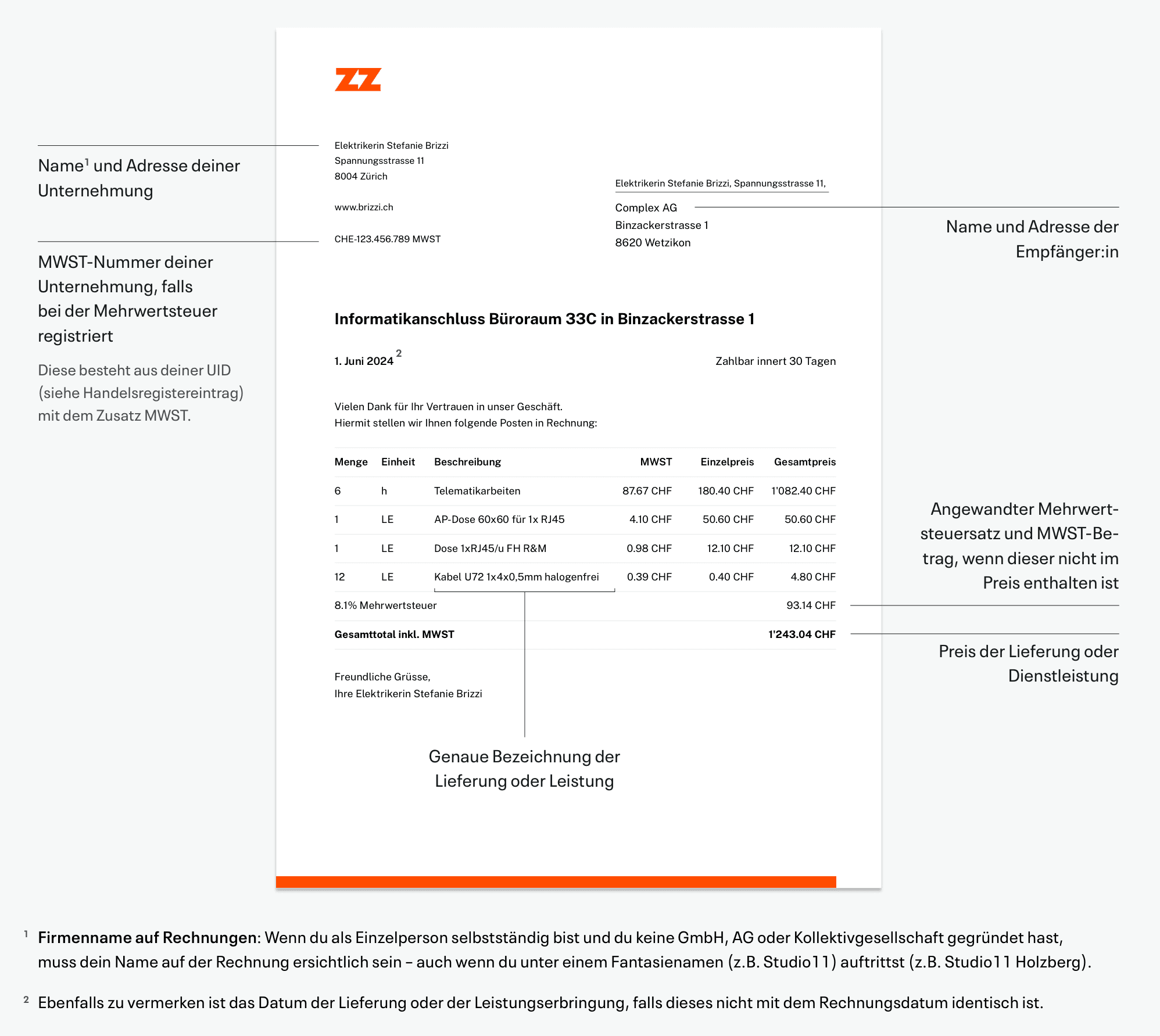
Swiss invoices must contain certain minimum information to be recognised as VAT-compliant by the Federal Tax Administration (FTA). The legal basis is Art. 26 of the Value Added Tax Act (VAT Act). These requirements apply whether you use invoicing software or create invoices manually.
The following information belongs on every invoice:
- Name and address of the issuer (for sole proprietorships: your legal name, even if you trade under a business name)
- Name and address of the recipient (mandatory from CHF 400)
- Invoice date
- Date of delivery or service, if different from the invoice date
- Precise description of the goods or services (type, scope, quantity)
- Amount payable
- VAT rate and tax amount, shown separately if you are subject to VAT
- Your VAT number in the format CHE-123.456.789 VAT, if registered
Use our free tool to create a simple Swiss QR-bill that takes all this mandatory information into account and makes your job much easier.
If one of these elements is missing, the recipient may not be able to claim an input VAT deduction, and the invoice can be challenged during a VAT inspection. In practice, that means the invoice may be returned and need to be corrected. It is therefore worth getting the mandatory information right from the start.
Company name on invoices
If you are self-employed as an individual and have not founded a GmbH, AG, or general partnership, your legal name must appear on the invoice, even if you operate under a business name such as “Studio11”. In that case, both are shown on the invoice: “Studio11 – Anna Holzberg”.
Date of delivery or service
The date of performance is mandatory if it differs from the invoice date. It shows when the service was provided or the goods were delivered. If this information is missing, the recipient may not be able to assign the expense to the correct accounting period, which can cause problems during an audit.
VAT number
If your company is subject to VAT, the VAT number should be clearly visible on the invoice. You received it from the Federal Tax Administration (FTA) when registering, in the following format:
CHE-123.456.789 VAT
The VAT number allows the recipient to claim the input VAT deduction correctly and simplifies the accounting process for both parties.
Recommended additional information
Beyond the mandatory information, the following details are almost as important in practice because they reduce questions and speed up payment processing:
- A clearly identifiable invoice number, for example sequential or year-based: 2026-001
- Clearly itemised invoice lines with individual prices
- Payment terms, including payment deadline and any early-payment discount
- IBAN or QR-IBAN for payment
Invoice with or without VAT
According to Art. 10 VAT Act, VAT liability generally applies from worldwide annual turnover of CHF 100,000. Businesses below this threshold may opt into VAT voluntarily, but they are not required to do so.
If you are subject to VAT, you show the applicable tax rate separately on the invoice: 8.1% standard rate, 2.6% reduced rate, or 3.8% special rate for accommodation. The current rates have applied since 1 January 2024.
If you use the net tax rate method, you still show the regular VAT rate on the invoice, not your net tax rate. This causes confusion for many businesses, but the rule is clear. You can find an overview of the current VAT rates in our VAT guide.
If you are not subject to VAT, it is advisable to add a note to the invoice, for example: “Without VAT – business exempt from VAT liability (turnover below CHF 100,000).” This prevents recipients from accidentally claiming an input VAT deduction.

Use our free tool to create a correct Swiss QR invoice online, including all mandatory information and the QR payment part, with no account required.
Structure of the QR payment part
The QR payment part consists of two sections placed at the bottom of the invoice: the receipt on the left and the payment part with the Swiss QR Code on the right. The QR code contains all payment information in machine-readable form and can be scanned directly by banking apps. This reduces manual entry errors and speeds up payment.
The QR payment part includes information such as:
- IBAN or QR-IBAN of the recipient, meaning the account to which the amount should be transferred
- Payment amount in Swiss francs or euros
- Name and address of the payee
- Name and address of the payer, optional
- Purpose and additional information, such as an invoice number or customer number
- Optional reference number, a unique identifier for fast allocation of the payment
There are three variants, which differ in how payments are allocated:
- QR-IBAN with QR reference (QRR): for automatic allocation using a 27-digit reference number. This is the most common option for businesses.
- Standard IBAN with Creditor Reference (SCOR): an international alternative based on ISO 11649.
- Standard IBAN without reference (NON): the simplest option when automatic allocation is not required.
For most Swiss businesses, the QRR variant is the most practical because it enables automatic payment allocation in e-banking.
New requirements from 2026: structured addresses only
Since November 2025, only structured addresses have been permitted in the Swiss QR Code. Instead of a combined free-text address such as “Musterstrasse 12, 8001 Zurich”, each component, street, house number, postcode, city, and country, must be stored in a separate field.
Important: From 30 September 2026, banks may reject QR invoices with unstructured addresses. Check now whether your software already creates structured addresses, otherwise you risk payments not being processed.
If you use modern invoicing software such as Infinity, you do not need to worry about this: addresses are automatically stored in structured form in the QR code. If you use a manual solution or older software, it is worth checking.
Create a QR invoice for free
For individual QR invoices, some banks offer a QR payment section generator directly in their e-banking. Alternatively, you can use websites such as qr-rechnung.net to create a standalone QR payment section. Make sure to also provide a complete invoice containing all legally required information.
If you regularly issue invoices, invoicing software can save you a lot of time. Customer details, products and recurring invoices can be saved and reused instead of starting from scratch every time.
With Infinity, you can create, send and manage invoices including the QR payment section directly. You can try Infinity free for 14 days.
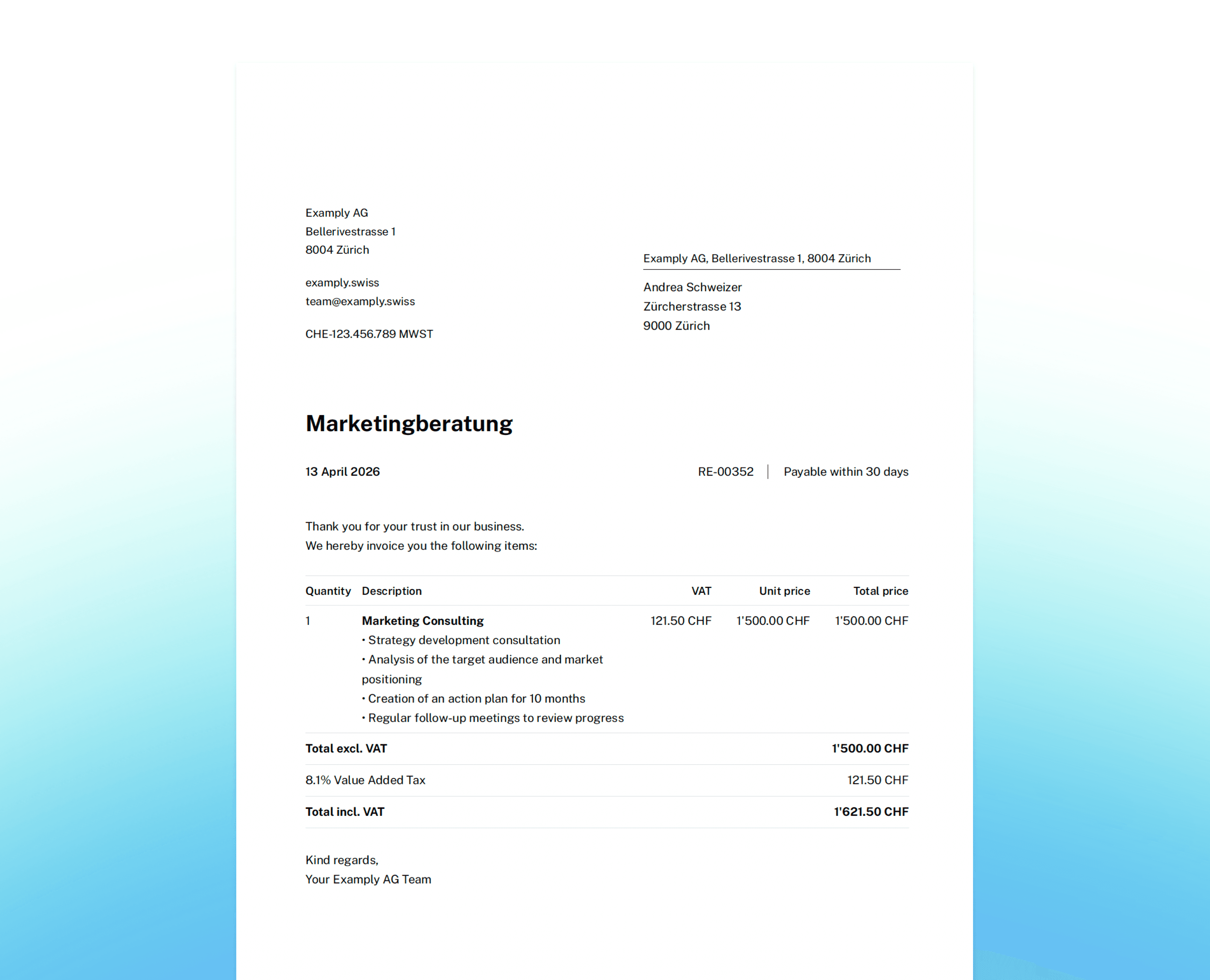
More on this in our dedicated guide: Writing a quote in Switzerland — required elements, validity & template.
From quotation to invoice
The typical process often starts with a quotation rather than an invoice. Under Swiss law (Code of Obligations, Art. 3 and Art. 7), a quotation is a binding offer. Once the customer accepts it, a contract is formed.
A clean workflow looks like this: create the quotation, wait for customer confirmation, provide the service or deliver the goods, then issue the invoice. If this process is handled in software, the quotation can be converted into a QR invoice with one click without entering the data again. This is how it works, for example, in Infinity with the visual editor.
For the full guide to QR invoices — including QR-IBAN vs. regular IBAN, the three reference types, and the 2026 structured address requirement — see: Create a QR invoice in Switzerland.
Payment deadlines and payment terms
Swiss law does not prescribe a specific payment deadline. You can define it at your own discretion. The most common terms in practice are:
- 30 days: the Swiss standard, especially in B2B business
- 14 days: common among freelancers and for smaller projects
- 10 days: when faster payment is preferred
Depending on the industry, expect around 10 to 30% of invoices not to be paid on time. Issue invoices promptly, ideally immediately after providing the service, and consider advance payments for larger projects to protect your cash flow.
More on this in our dedicated guide: Writing a payment reminder in Switzerland — deadlines, template & debt collection.
Early-payment discount as an incentive
An early-payment discount is a reduction in price when the customer pays before the standard deadline. For example: “2% discount if paid within 10 days, net 30 days.” This creates an incentive without shortening the standard payment term. State the conditions clearly on the invoice to avoid misunderstandings.
What to do about unpaid invoices
If an invoice remains unpaid after the payment deadline, you generally have the right in Switzerland to initiate debt enforcement directly, without first sending a reminder. In practice, however, a staged approach is usually advisable before starting formal debt enforcement proceedings:
- Payment reminder: friendly and sent shortly after the due date
- First reminder: firmer wording with a new deadline, for example 10 days
- Second reminder: note any default interest and the possibility of upcoming debt enforcement proceedings
According to Art. 104 of the Swiss Code of Obligations, you may charge default interest of 5% per year. A higher rate is only permitted if it has been contractually agreed, for example in the terms and conditions.
If payment is still not made after the second reminder, you can submit a debt enforcement request to the responsible debt enforcement office. The Swiss SME Portal explains the process in detail.
More on this in our dedicated guide: Writing a payment reminder in Switzerland — deadlines, template & debt collection.
Special cases in invoicing
Not every invoice follows the standard pattern. Some special cases appear regularly in practice:
- Pro forma invoice: an invoice without a request for payment, for example for customs purposes or as advance information. It is not a tax-relevant document.
- Advance invoice: used for larger projects before the final invoice. VAT is shown proportionally on the advance invoice.
- Credit note: corrects an invoice that has already been issued, either fully or partially. Important: the original invoice number must be referenced.
- Cancellation invoice: fully reverses an incorrect invoice before a new one is issued.
More on this in our dedicated guide: Pro forma invoice, advance invoice & credit note — special cases explained.
Digital archiving and retention requirements
In Switzerland, business records, including invoices, must be retained for at least ten years under Art. 958f of the Swiss Code of Obligations. The retention period begins at the end of the financial year in which the invoice was created.
Digital and paper documents are generally considered equivalent as long as the accounting records are maintained properly. This means you can archive invoices digitally and dispense with physical copies if the documents remain accessible at all times and are stored in an unaltered form.
Invoicing software with integrated document storage, such as Infinity, handles this automatically: every invoice created or received is stored and remains accessible throughout the entire statutory retention period.
Writing invoices with the right tool
Creating invoices manually in Word or Excel works, but it does not scale. Businesses that issue invoices regularly benefit from software that creates standards-compliant QR invoices, calculates VAT automatically, manages customer master data, and records each receivable directly in the accounts.
More on this in our dedicated guide: Invoicing software Switzerland — the best tools for SMEs compared.
With Infinity, you create QR invoices and quotations in a visual editor, send them by email or link, and see at a glance which receivables are open, paid, or overdue. The accounting runs in the background, including AI-supported booking suggestions through Live Accounting.
Frequently asked questions
Do I need a QR invoice, or is a conventional invoice enough?
You are free to issue an invoice without a QR payment part. A QR invoice does, however, make payment much easier for your customers: they simply scan it in their banking app and all data is transferred automatically. This reduces errors and speeds up incoming payments.
What must an invoice contain for the input VAT deduction to be valid?
All mandatory information under Art. 26 VAT Act: name and address of both parties, description of the goods or services, invoice date, amount, VAT rate and VAT amount, and the VAT number of the issuer. If one of these details is missing, the FTA may challenge the recipient’s input VAT deduction.
Can I choose the payment deadline freely?
Yes. Swiss law does not prescribe a specific payment deadline. You can choose it at your own discretion. Common terms are 10, 14, or 30 days. State the deadline clearly on the invoice to avoid misunderstandings.
Do I have to send a reminder before starting debt enforcement proceedings?
No. In Switzerland, you may submit a debt enforcement request directly once the payment deadline has passed. In practice, however, it makes sense to send a payment reminder and one or two formal reminders first. Many unpaid invoices have simply been forgotten rather than deliberately ignored.
How long do I need to keep invoices?
Ten years from the end of the financial year in which the invoice was created, under Art. 958f of the Swiss Code of Obligations. Digital and physical documents are treated as equivalent as long as the accounting records are maintained properly.
What changes for QR invoices from September 2026?
From 30 September 2026, Swiss banks may reject QR invoices with unstructured addresses (type K). Only structured addresses (type S) with separate fields for street, house number, postcode, and city will be processed. Make sure your invoicing software already creates structured addresses.