

For SMEs and startups in particular, the issue is often more complex than expected: Expenses, fringe benefits, business vehicles or participation programs must be correctly declared. In this article, we explain clearly and comprehensibly:
- What is a salary statement
- Which information must be included
- What are the typical mistakes
- What role modern, AI-based payroll systems play in this
What is a salary statement?
The salary statement is an official tax document in Switzerland. Employers issue it to their employees annually. It serves as the basis for the private tax return.
Definition:
A salary statement is the employer's official certificate of the salary paid out and all monetary benefits of an employee within a calendar year.
It is also transmitted directly or indirectly to the responsible tax authorities (depending on cantonal regulations and ELM process).
What information should be included in the salary statement?
A salary statement contains more than just gross pay. Typically, the following positions must be correctly identified:
1st gross wage
- fixed wage
- bonus payments
- commissions
- gratifications
2. Social security deductions
- AHV/IV/EO
- ALV
- Pension Fund (BVG)
- NBU (non-occupational accident)
3. Expenses and allowances
- lump sum expenses
- Effective expenses
- Car indemnities
4. Fringe Benefits
- Business vehicle (private share!)
- Free or discounted meals
- Investments/employee shares
- perks
Mistakes often happen, especially with Fringe Benefits, as many entrepreneurs do not know what is relevant for tax purposes.
Who is required to issue a salary statement?
The following applies in Switzerland: Every employer is required to issue a salary statement for every employee.
This applies to:
- SMES
- Startups
- AGs and GmbHs
- Associations with employees
- Also for managing owners with payroll
Freelancers without employment do not receive a salary statement, but settle their own accounts.
By when does the salary statement have to be prepared?
The salary statement must generally be issued by the end of January of the following year.
example:
The salary statement for 2025 must be delivered by the end of January 2026 at the latest.
Many cantons also require electronic transmission via ELM (Uniform Payroll Reporting Procedure).
Typical mistakes with the salary statement
Errors often occur, especially with manual payroll accounting:
- Private share of business vehicle calculated incorrectly
- Expenses wrongly declared
- Bonus payments are not correctly taken into account
- False social security deductions
- Participation programs shown incompletely
Such mistakes lead to inquiries from the tax administration — or to unpleasant discussions with employees.
Why the wage statement is becoming more complex for SMEs
The Swiss payroll system is heavily regulated. In addition, there are:
- Several social insurance funds
- Different cantonal tax practices
- Swissdec/ELM standards
- Home office regulations
- Participation models for startups
The more modern a company is organized, the more demanding the correct declaration becomes.
Create a salary statement digitally: avoid risks with payroll software
The salary statement is not an isolated document.
It is the result of correctly managed payroll processes throughout the year.
Many mistakes do not occur at the end of the year — but during the ongoing payroll process:
- Wage components entered incorrectly
- Social security contributions are not correctly deposited
- Incorrectly recorded private shares or expenses
- Changes during the year are not properly documented
Whoever carries out payroll manually or in Excel significantly increases the risk of inconsistencies.
How can these risks be avoided?
The most important lever is structure.
When payroll is managed cleanly digitally, payroll statements are automatically created from the collected data — instead of as a separate annual project.
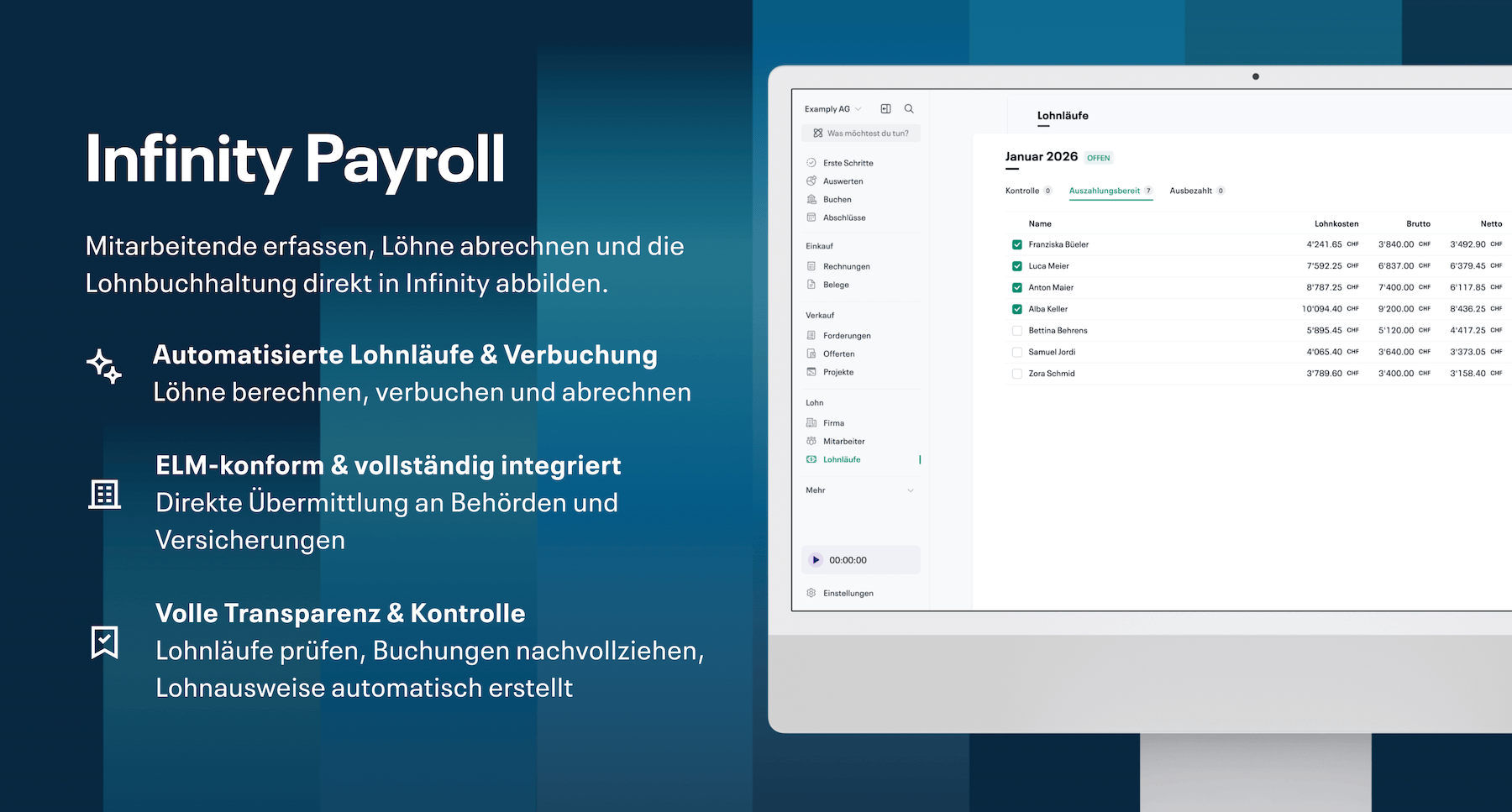
With payroll software such as Infinity Payroll, this means in concrete terms:
- Wages are recorded systematically
- Social security calculated correctly
- Payroll entries automatically transferred to accounting
- The salary statement is automatically generated at the end of the year
- The transmission is standardized via ELM
The advantage:
The salary statement is no longer a manual compilation, but the result of consistent processes.
What to do in case of uncertainty?
Not every SME wants to handle payroll entirely by itself.
There are three useful options:
1. Manage payroll yourself — with software
Structured payroll software is perfect for teams with uncomplicated work relationships and some accounting expertise. It reduces sources of error and ensures clean annual financial statements.
2. Incorporate trustees
Anyone who needs selective support can use the Infinity escrow directory find a specialist trustee
3. Outsource payroll completely
If you want maximum relief, you can completely outsource wage administration — to our partner, for example Quit business.
Conclusion: The salary statement is a process, not paper
The salary statement itself is not a complicated document.
It becomes complex when processes are unstructured.
Companies avoid risks when they:
- Manage payroll digitally
- Documenting payroll processes cleanly
- Work in accordance with ELM
- Involve external expertise as needed
Modern payroll software doesn't replace expertise — but it creates structure.
And structure is the best protection against salary statement errors.
Frequently asked questions about the salary statement
Does a salary statement have to be prepared even for very low wages?
Yes Even with part-time or low income, there is an obligation to exhibit.
What happens if there are errors in the salary statement?
A corrected salary statement must be prepared and resubmitted.
Are there any sanctions?
If an incorrect declaration is made intentionally, there is a risk of tax consequences.


